
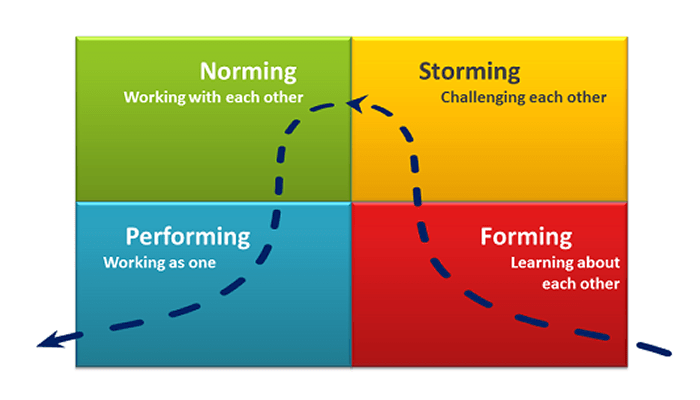
It wasn’t until this year that I stumbled upon the Tuckman Model -a model used to represent the stages of team development. As you can see from the model there are 4 to 5 stages (depending on which one applies to your field).
In my short time with a large group of new Teammates, I challenged myself to align the model with the three weeks I have with them. At first, I was unsure about its effectiveness because I had the model aligned on a company-wide picture. So of course I was pulling hairs out because I was trying to align unknown variables. LOL! However, once I understood to conceptualize it as a “Responsive Design” model (for all the Web Development savants)- in other words, apply it within my role/scope- it became clear how to. Mapping out those stages helped me understand which Leadership tools to use.
For example, during the FORMING STAGE, it is very common for everyone to feel “shy” and exhibit reserved behaviors -from crossed arms in body language to higher inflections at the end of their verbal answers (indicating uncertainty). Everyone is unsure of what to expect and so, anxiety will skyrocket during this stage, making it totally understandable why people exhibit those behaviors. As a Leader in this stage, it is best to literally take the lead and direct people. I like to explicitly say “you will be in charge of…” or “your responsibilities in your role are…” x, y, z. Or if I’m directing a task, “your task as of right now is…” x, y, z. No room for gray areas as you lead laying the land with them.
During the STORMING STAGE, is very common for everyone to begin to “show their ‘truer’ colors” and exhibit more apparent behaviors of conflict/curiosity. Everyone feels that now they have a bigger lay of the land, it is okay to “test boundaries”. Some people might ask questions that challenge the status quo. Some people may bypass questions and provide opinions about the status quo. Or maybe not the status quo, but rather another teammate’s perspective. As counter-intuitive as it may feel, this is where Leadership ought to welcome it and reassure conflict and curiosity are welcome… after all, it is expected. This is where you provide Rationale for every task you have them follow… LOL if you have many. The point is, you want to excel at explaining the why -the bigger picture of why you’re asking them to trust in you and your directions. You’ll want to turn your “red-light” of directives from the previous stage, into an “orange light” of guidance for this stage, instead.
The next stage is the NORMING STAGE. In this stage, it is very common for people to “have less need for you” (trust me, this isn’t the saddest phase as a Leader lol). It’s when our teammates have a better, solid understanding of each other’s strengths and weaknesses and begin to perform on their own without a majority of understanding how to execute their role. For example, they will begin to show independence and initiative, however, they will still have questions. Your role as a Leader is to provide support; answer their questions, point them in the right direction, provide encouragement and/or reassurance. You may even want to ask “how would you go about this (having learned everything you did)?”.
And then we have the PERFORMING STAGE. This stage is when people are ultimately exhibiting highly independent behaviors when executing their responsibilities. You truly are needed less for their execution. They have less questions regarding their responsibilities they were shown and taught. As a Leader, in this stage you would begin to entrust them with tasks and decision-making. Your role would switch from supporting to delegating. You would delegate them with a task, entrusting them to execute it. Based on your judgement you would move delegating tasks to decision-making (on the longer term); for example, for me, I need to see consistency with task-completion first in order to delegate decision-making. Another common thing you would see in this stage is people seeking you out to improve their execution. When you see this happen, please tell me you DON’T get misty-eyed LOL. This behavior -soliciting feedback- is a clear indicator someone is either up to speed or further ahead of the team with their potential. In other words, when you have people approach you for feedback, you know you did well by leading them into this stage.
And finally, the ADJOURNING STAGE, the stage where you say “bye”, “farewell”, “I wish you the best on your next endeavor”, etc. As you experience all the feels, as a Leader you would help the team recognize all of their achievements, appreciating them for all they’ve done and become proud of all the learning, and ease them into the next stage of their growth. As someone who experienced stagnation due to management not wanting me to grow because they needed someone at that role I was in, I see tremendous value in this phase. What’s the point of helping your Team expand their wings if not put to fly?
This model has helped me conceptualize timelines and what behaviors to look for. I’ve found this tool to be very helpful and I hope it provides the same for you.
🔴 Be Empowered, my friends.


Leave a comment